How to share KTLO without burning out your engineers
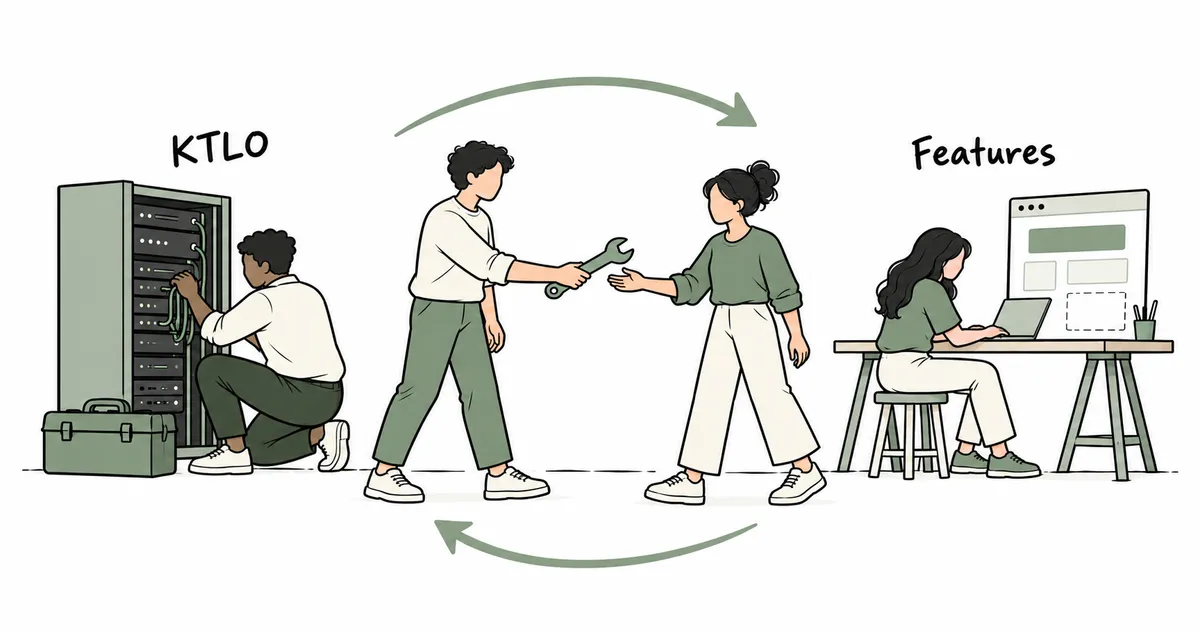
Earlier in my career, I managed an area with two kinds of work. We had legacy systems, and we had new systems and new products to build. The legacy systems were giving us a lot of issues.
So I made what felt like a sensible decision. I built one permanent team to manage only the legacy systems, while the other teams worked on the new, shiny products.
It was one of the biggest mistakes of my career.
What happened to that team
The legacy team was made of very good engineers.
Their day-to-day was migrations, maintenance, updates and incidents. Nothing else.
They started complaining to me, and they kept complaining. They felt it was unfair: they were the ones dealing with the mess other people had left behind, paying for other people’s wrong decisions from the past. Some of them asked to leave the team. Engagement dropped a lot. At some point the whole team was really disengaged, and nobody believed in the model.
I kept it going for months before I changed it.
Why a KTLO team burns people out
KTLO stands for Keep The Lights On: all the work that isn’t launching features or products for your users. A KTLO team is a team that only does that work.
Most of what lands on a KTLO team is reactive, short-term KTLO: incidents, and hard deadlines from audits and compliance. That means working continuously under stress, reacting to unexpected events. Nobody likes that as their whole job. Strategic KTLO, like re-architecting a system so it can scale, is different, but it’s rarely what fills a KTLO team’s week when things are not under control.
This burns people out so reliably that it works as a weapon. If you ever want to have dinner with Lucifer, try this: when you want an engineer to leave your company, put them on a KTLO team and leave them there until they quit. That’s a mean practice, and I hope nobody does it on purpose. But if you build a KTLO team, you’re doing exactly that to people, without meaning to.
Is there anyone who enjoys this work full time? I’ve never met an engineer who did. The only exception I’ve seen is very junior engineers who are still learning. Because everything is new to them, they accept most kinds of work. That doesn’t last, and it isn’t a reason to build a team around it.
So the answer is to share KTLO across the engineers who also build features. How you do that depends on how many teams you have.
If you have one team: the firefighter
With a single team, the small version of my mistake is making one engineer the permanent “KTLO person”. It burns them out for the same reasons.
What I use instead is a firefighter role. Every week, one engineer takes all the KTLO duties: incidents, support requests, the interruptions. The rest of the team keeps delivering features. The next week, the role rotates to someone else.
Everyone carries KTLO, nobody carries it all the time, and the rest of the team gets a week of focus while the firefighter protects them.
If you have several teams: a team of firefighters
With several teams, you can extend the firefighter idea into a virtual team.
Imagine three teams of five engineers. Take one engineer from each and form a virtual team of three. Now you have three feature teams of four, and one team of three that only does KTLO.
That sounds like the mistake I made, with one big difference: nobody stays. Every week, one engineer from each team rotates in, and the previous three go back to their teams. It’s the firefighter role scaled up: a team of firefighters instead of one.
This gives you three benefits:
KTLO is concentrated in one place, so the feature teams deliver without interruptions.
People work with colleagues they’ve never worked with before. It’s like going on Erasmus for one week!
You get a simple measure of KTLO. The size of the virtual team is the share of capacity going to KTLO. Three engineers out of fifteen is 20%. No surveys, no ticketing, no AI.
Another option for several teams: houses
Another model I use is what I call a house system.
Take an area with nine backend engineers in three teams of three, each team managing a couple of microservices. In the classic setup, each team owns its own services, maintenance and incidents included.
With houses, the shared systems are owned at group level instead of team level. Each system, or group of related microservices, belongs to a house. Engineers from different teams are members of the house, distributed by expertise and seniority. If a system needs more maintenance, its house gets more engineers. It works like a guild.
This turns the three teams into pure feature delivery teams. Maintenance lives in the houses.
You can combine it with a Shape Up-style cycle, for example:
6 weeks delivering features
1 week planning
1 week housekeeping
During the housekeeping week, engineers temporarily leave their feature teams and group into their houses. They do upgrades and maintenance, scale things, and clean up what the delivery weeks left behind.
It’s a fairly advanced model, and it needs its own post, which is coming. But the engineers really like it.
The takeaway
Don’t build a team whose whole job is KTLO. It will burn out good engineers, and it may push them out of your company. Share the work instead: a rotating firefighter if you have one team, a rotating team of firefighters or houses if you have several.
Nobody should end up on Lucifer’s guest list. My Operational Excellence course shows how to build stable systems so your team can focus on building instead of firefighting.
About the Author

Angel Anson has spent over 20 years in the tech industry, working across startups, scaleups, and large organizations such as King (Candy Crush), N26, Scytl, RentTopApartments, and Emte Sistemas. Throughout his career, he's held roles like Software Engineer, Tech Lead, Engineering Manager, Head of Engineering, Tech Director and Director of Engineering, and has also founded two companies — one as a co-founder and one independently. His experience spans fintech, gaming, government technology, and enterprise software, where he's led teams building products used by millions of people worldwide. Today, he serves as Director of Engineering at N26, leading more than 100 people, and is the founder of Engineering Manager School, an initiative that helps professionals improve their management and soft skills and lead with clarity and confidence. Over the years, Angel has mentored more than 100 professionals in tech and product roles, helping them grow into stronger, more intentional leaders.